Sunday, 11 December 2011

The profile

The King's Speech Profile

Synopsis
The King's Speech tells the story of the man who became King George VI, the father of Queen Elizabeth II. After his brother abdicates the throne, George (Bertie) reluctantly becomes King. Plagued by a dreadful stammer and considered unfit to be King, Bertie engages the help of an unorthodox speech therapist named Lionel Logue. Through a set of unexpected techniques, and as a result of an unlikely friendship, Bertie is able to find his voice and boldly lead the country through war.

 
What is the Genre?

The King's Speech is a period drama, so it had to be authentic - combining regal opulence and scruffy, depression-era London.


Who is the Target Audience?
The original target audience was the members of the Academy - those who vote for the nominations in the Oscars. According to statistics, the average age od Oscars voters is 57 years old.  As The King's Speech was not a mainstream film but instead an independent and art house film, it relied on the reviews on the film at the various film festivals that it was entered in. Due to it's excellent reviews at the events, there became a general buzz of excitement, and the film went mainstream.


The film was initially given a 15 rating by the British Board of Film Classification for its release in the United Kingdom, due to scenes where Logue encourages the King to shout profanities to relieve stress. At the London Film Festival, Hooper criticised the decision, questioning how the body could certify the film "15" for bad language but allow films such as Salt (2010) and Casino Royale (2006) to have 12A ratings despite their graphic torture scenes. 


Following Hooper's criticism, the board lowered the rating to "12A", allowing children under 12 years of age to see the film if they are accompanied by an adult. Hooper levelled the same criticism at the Motion Picture Association of America, which gave the film an R rating, preventing anyone under the age of 17 from seeing the film without an adult. This rating was not appealed. 


In his review, Roger Ebert criticised the R rating, calling it "utterly inexplicable", and said, "This is an excellent film for teenagers". In January 2011, executive producer and distributor Harvey Weinstein said he was considering having the film re-edited to remove some profanity, so that it would receive a lower classification and reach a larger audience.


The film was re-released in the USA on 1 April with a PG-13 rating, replacing the original R rating.


Director
Tom Hooper was the director. He has directed films including Elizabeth I, which was about royalty like the King's Speech, as well as the Damned United, which was again, based on true events. 


In both the King's Speech and the Damned United, Tom Hooper filmed at Leed's United football ground, Elland road. At the start of the King's Speech, when the Prince is giving a speech in Wembley, it is actually filmed at Elland Road. It was chosen because of the resemblance it had to a 1925 version of Wembley stadium.


Budget
The UK Film Council, which is to be cut, contributed £1 million to the overall budget.


However, 
The lion's share of its £10m budget came from the Aegis Film Fund, a consortium of private investors that also contributed to another Firth release, St Trinian's 2.


The film also received money from the film's UK distributor Momentum and the London-based post-production company Molinaire.

Some credit should also go to the European Commission, which contributed £480,000 towards its distribution costs via the EU Media fund.
Distributors
The film is distributed by Transmission in Australia and by Momentum Pictures in the United Kingdom. 
The Weinstein Company is the distributor in North America, Germany, Benelux, Scandinavia, China, Hong Kong and Latin America. 
The film was released in France on 2 February 2011, under the title Le discours d'un roi. It was distributed by Wild Bunch Distribution.
Box Office
In the UK and Ireland, the film was the highest earning film on its opening weekend, it took in £3,510,000 from 395 cinemas. The Guardian said that it was one of the biggest takes in recent memory, compared to Slumdog Millionaire (2008), which, for example, two years earlier earned £1.5 million less.

In total, it has so far made a worldwide total of over $400 million.

Campaign

The King's Speech Marketing Campaign

As an independent film, the King's Speech was not able to use a huge budget of Hollywood levels to market it and get it recognized. With a budget of only around £8million - £12 million, it could not compete with major blockbusters with backing from massive institutions such as Universal or 20th Century Fox.


Instead, the King's Speech used viral marketing to draw attention to the film - and it proved just as effective, if not, more. The film was made just in time to enter it into several film festivals in the hope that national newspaper journalists will enjoy it and write about it in their papers. 


Luckily, the reception of the film was brilliant, and even before the film had been released in cinemas, people were talking about it and saying how good it was, whilst tipping it for many awards including some Oscars. 


Other methods of marketing include the posters and trailers. 


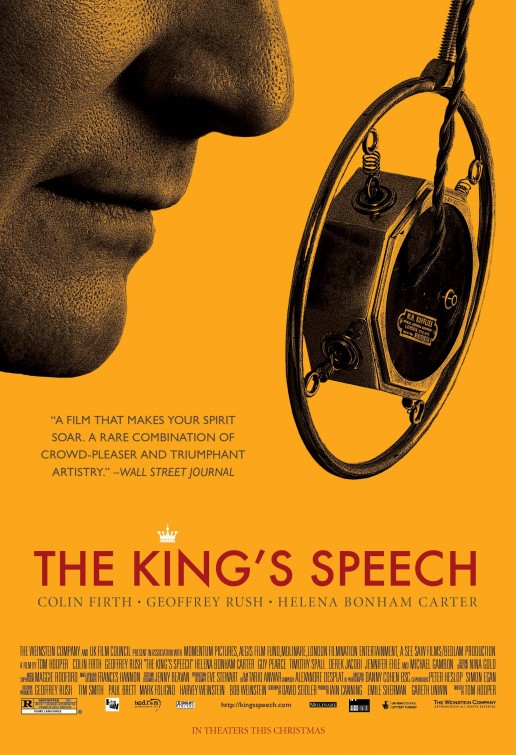
The posters are very clear and simple. The two shown here present the audience with the two main characters and stars of the film. The pictures are close ups of both the Kings and Lionel Logue, his speech therapist. 


The top one has big, bold words from reviews in newspapers which describe the film. Of course, they are all highly positive quotes of the film and they encourage the audience to go and see the film for themselves. 


The poster gives very little away, and although could be seen as plain, it is effective in emphasising the words which describe the film. The words are all in capitals, which again, draws attention to it and suggests that what is being said is important.


The way the two men are dressed shows their high status and importance of them in society as well as the film's story.


The title of the film uses interesting typography, which looks royal and important, with a King's crown for the dot above the "i" in King. This again highlights the fact that this film is about a king and an important speech.


The fact that in the second poster, the words "God" and "King" are both equally sized in comparison to the "save the" in between again shows the status of the King and the importance in society that he represents. 

The Kings speech Questions (Distribution)

Who distributed the film in the UK and USA and what were the issues associated with the film’s distribution?
·         Weinstein Company, The (2010) (USA) (theatrical)
·         Anchor Bay Entertainment (2011) (USA) (DVD) 
·         Anchor Bay Entertainment (2011) (USA) (DVD) (Blu-ray)
·         Momentum Pictures (2011) (UK) (all media)

 Was the campaign a grass roots or mainstream big event? How was word spread about the film? Virally on the Net? Mass advertising campaign with poster, trailers, etc?

The King's Speech was originally an independent film/arthouse film, but due to it's success at the various film festivals, listed below, the interest immediately increased and the film was turned into a mainstream film.

·        Telluride Film Festival
·        Toronto International Film Festival
·        Mill Valley Film Festival
·        Hamptons International Film Festival
·        London Film Festival
·        Leeds International Film Festival
·        AFI Film Festival
·        Bahamas International Film Festival
·        Dubai International Film Festival

There were a variety of posters as well as a few different trailers for the UK and America which were intended to interest the respective audiences. The King's Speech official trailer has 895,399 views onYouTube. The trailer was put up on YouTube on 28 Sep 2010, while the release date was three months later. This enables a large audience to watch the trailer and wet their appetite for the film which is to come out in a few months. 

On the video description, it gives the following information:
Release Date: 10 December 2010
Genre: Drama | History
Cast: Helena Bonham Carter, Colin Firth, Guy Pearce, Michael Gambon, Tim Downie
Director: Tom Hooper
Writer: David Seidler
MPAA: R
Studio: The Weinstein Company


It then goes on to explain the plot and a link to subscribe to the YouTube channel.

• How was “the talent” used to publicize the film? For instance,
TV and radio interviews with members of the cast, director, etc.


Colin Firth was interviewed on Piers Morgan’s American chat show: Piers Morgan Tonight. Show averages 978,000.

Colin Firth was also on The Late Show with David Letterman to promote The King’s Speech. Show averages around 914,000.

The main stars of the play are the subject of interviews just before and just after the realease of the film, with journalists taking turns to have a one-on-one interview with them as they sit in front of a advertising poster for the film. The interviews are shown on all different types of channels all over the world for different networks, which immediatley raises the profile of the film again.

Interviews like these were conducted with the stars; Colin Firth, Geoffrey Rush and Helen Bonham-Carter, as well as the director, Tom Hooper.

• Who was the main target audience for the campaign? Why?

The target audience for The King's Speech has a lot in common with its other target: the members of the Academy, who are set to cast their ballots for this year's Oscars. According to statistics compiled by The Hollywood Reporter, the average age of Oscars voters is 57.7 years old. With $180,443,023 collected worldwide so far on a $15 million budget, the film has been a definite hit, and if my theatre experience is anything to go by, that 57.7 age range is being reflected in the vast majority of the people who are seeing this movie. You can see, then, why this movie has suddenly started to dominate this awards season.

Friday, 9 December 2011

British Cinema Research

(Greenwich) Odeon
Movie Name: 50/50 Made by:United States
                   A Very Harold & Kumar 3D Christmas Made By: USA
                   Alvin And the Chipmunks- Chipwrecked Made By: USA
                   Arthur Christmas 3D Made by:USA
                   Desi Boyz Made by: India
                   Happy Feet 2 3D & IMAX Made by:USA
                   Hugo 3D Made By: United States
                   Immortals Made By: United States
                   In Time Made By: United States
                   Ladies Vs Ricky Bahl (Bollywood) Made By: India
                   New Year's Eve Made By: USA
                   Puss in Boots 3D & IMAX Made By: United States
                   The Adventures Of Tintin: Secret Of The Unicorn 3D Made by:Usa
                   The Big Year Made by: UK
                   The Help Made by: USA
                   The Smurfs 3D Made By: USA
                   The Thing Made by: USA
                   The Twilight Saga: Breaking Dawn Part 1 Made by:USA
                  Tower Heist Made By: USA
What Proportion are produced by American film Companies and how many are produced by British film companies?
A majority of the movies are made by the USA as it seems they have alot of facilities when it comes down to making movies. Only one film from the Odeon was made by a British company.


Do the films that are showing reinforce contemporary western culture as being dominant and positive, or challenge the dominant ideology and depict the more dark, weaker parts of our society?
The films reinforce contemporary western culture as being dominant and positive as the movies are all crowd pleasers their not movies that challenge the audience or make them think. Its just for entertaining purposes that they believe people will relate to.


If you find that one type of film (American or British) is shown more in cinemas why I think this is?
American movies are shown more in cinemas and I think this is because they have the most access  to media and the film industry. Most of the main film distributors are in the usa like Mirmax, warner bros. Also it costs a lot to publish your movie in a mainstream cinema. So most of the low budget movies distribute their movies to independent cinemas rather than the mainstream. British movies have not yet come to popular by mainstream cinemas as they do not have the budgets.


Do you think one of these types of film is more popular with an audience and if so why?
I think American movies are because most of the popular actors are american also the movies tend to have a lot of special effects. They more of the latest technology to create animation and action/adventure movies. 


Digital Tv

Definition:
Digital television is the transmission of audio and video by digital Signals, in contrast to the analogue signals used by analogue TV. Examples could be watching it with free view or signing up with a company. Examples are Sky anytime, Sky plus, Virgin Media, HD TV, Free sat.
What can audiences do with it?
They can get packages for example the Sky package where they have sky plus and they can put record on films and programs and reminders. They can access more channels and games with packages that come with Internet access on the skybox. Also with packages they send you a TV guide home of what is coming on your TV and it also says what films are premiering on the movie channels. They also have a kid’s magazine that put games and entertainment for them.
They also have sky anytime where the people who make sky record programmers’ and films for people that have just come out or seem to be popular.
Why do the audiences like it?
The audiences like it as it offers an easy solution rather than always going to the cinema. Plus it can be seen to be cheaper. For example with sky they do a 2 month free trial on the movies channel. Then after that you would pay £27.50 a month.
How it benefits audiences?
As before in the 1950’s you would expect to see the news and soaps. As TV was only broadcast for 3 hours a day. Also people could not afford TV it was very expensive until 1953.
But now you can watch anything you want on TV it has more channels and is on everyday at anytime for anyone. So it is more accessible for people. It gives them updates on what’s new.
How has it changed the way audiences can access films?
You can subscribe to the skybox channels. Where they play exclusive films. Its changed the way the audience access films a s normally they would go to the cinemas. Also on free view if you don’t want to pay they give you Film4 and channels like e4 and channel 4 normally play films. For example E4 has the slackers club that provides you with free cinema tickets to a movie that the show at a cinema every month.
How does it help the film industry to produce, market, sell, and distribute the films and why do the film industry like it?
When a movie comes out they show adverts on TV and competitions for the movies. Also they might do special programmed on TV to do with the film. Example with the king’s speech it is based on the true story of the queens Dad and so channel 4 did a documentary on the events of the king. Film4 fund British film
It can increase the ratings of a movie and also the popularity of the movie. (Good way to advertise a film as more people nowadays watch TV)
How have the film industry incorporated it into production, distribution and marketing?
As they can catch up on films on anytime TV and on the movie channels. Also they have box office were you can rent the latest movies that have come out recently. Distribution companies by advertising space on digital TV channels, example would be to target a later audience. 
The presentation
I think my groups presentation went well I contributed a lot to the group and used examples from my own experience of what I have seen on Tv  

Monday, 21 November 2011

Distribution and Marketing

The Marketing Campaign's for The Kings Speech and Tin Tin:


In The Kings Speech they used Posters that had catch phrases like 'God save or king'While the poster makes it clear this is based on an “incredible” true story it oddly doesn’t include any of the endorsements the movie has racked up to date, either in the form of showing off its festival appearance badges or by using some of the press quotes that have praised the movie based on those screenings. It also has different trailers that they brought out for example the first trailer was more informative telling you the story-line whilst the others are showing clips to draw people in to watch the movie, online they have a official website where you can find out information about the movie and the cast, advertising and cross-promotions they used online to also post adds  (little posters) on websites but they rarely used that. 
Media and Publicity in Word of mouth buzz for the movie really came out strong after its debut at the 2010 Telluride Film Festival. There it racked up some serious positive press not only for the movie as a whole but also for Firth’s performance as the man who would be king. It became an almost immediate awards contender(Los Angeles Times, 9/11/10) and was even labeled (Hollywood Reporter, 9/13/10) as the movie that might bring The Weinstein Co. back to the glory the brothers enjoyed during the heyday of Miramax.


In Tin Tin has brought out two trailers and a number of clips from the movie that are action filled to make people want to watch more. Also they used billboard posters at bus tops, motor ways and Tv adverts.
 Who distributed the film in the UK and USA and what were the issues associated with the film’s distribution: The kings speech came from lottery money and was distributed by the UK film council. Also with Tin Tin it was a cartoon before it became the movie. So most of its popularity and audiences came with the knowledge of that. As they may of watched the cartoons.

Thursday, 3 November 2011

Media questionaire


We had to do a questionaire on the media intake of people in our class.
The questions I asked were :
  • What favourite genre of movies they liked
  • What was the common ways for them to watch movies
  • What way did they use the most to watch movies when they were children
  • Their age group they were in and their gender.#
I found out the gender and age group that you are in effects the genre of movies they liked. For example I found out that with girls aged 16 to 17 they preffered Horror, aAventure and Drama genre movies. Whereas with boys age 16 to 17 they preffered Comedy (also Black comedy), Action and aventure. But both gender groups said the most common ways for them to watch movies was to go cinema then on DVD and then it was to watch movies online.